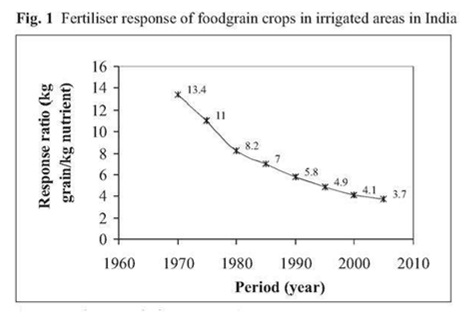
From the 90s, there has been a debate in the policy, academic and civil society circles on the ill effects of Chemical Fertilizers on soil health and food security. Government of India acknowledges the problem only in 2009, when then Union Finance minister Sri Pranab Mukherji in Parliament during his budget speech said, “In the context of the nation’s food security, the declining response of agricultural productivity to increased fertilizer usage in the country is a matter of concern. To ensure balanced application of fertilizers, the Government intends to move towards a nutrient based subsidy regime instead of the current product pricing regime…”
Chemical fertilizers are destroying the soil food web and the living organisms that create soil fertility, soil aggregates and healp conserve water in the soil. Industrial agriculture therefore contribution to desertification and increasing drought, affecting food security, livelihood security as well as making agriculture more vulnerable to climate change.
According to FAO — Healthy Soils are the foundation for food, fuel, fibre and even medicine. So we definitely need healthy soils for growing healthy food as well as healthy environment.
According to the Soil Association in order to tackle the issues and challenges and to achieve the UN Millennium Development Goals of environmental sustainability and eradication of extreme poverty and hunger, food and farming systems which put local needs first and which follow organic and sustainable agriculture principles are key.
Organic Agriculture and Living Soils: Solutions to Hunger Poverty and Climate Change
Soil is a living system, a living entity. The life in the soil (soil organisms, both macro and micro) not only helps farming but humanity as a whole. So to keep the soil living it is important to:
Incorporate organic matter food for living organisms;
Protect it from erosion and
Stop using chemicals and adopt organic and agro-ecological practices for soil health management
Hans Jenny (in Stuart 1984) wrote: “If all the elephants in Africa were shot, we would not notice it, but if the nitrogen fixing bacteria in the soil, or the nitrifiers, were eliminated, most of us would not survive for long because the soil could no longer support us”.
Soil provides the basis of all plant, animal and human life on Earth. A healthy soil supports plant growth, has the ability to purify air and water and safeguards animal and human health. One cannot imagine about food without soils. There can’t be healthy food without healthy soils.
Soils are vital for any ecosystem that plays a key role in the carbon cycles, storing and filtering water, improving resilience to different climatic conditions like floods and droughts etc.
After oceans, soil is the second largest carbon sink on the planet. Soil can nourish carbon-based plants and maximize carbon fixation while minimizing the release of CO2, reversing the effects of climate change. All of these benefits are dependent on the small fraction of soil inhabited by living organisms that comprise the soil food web.
A fossil fuel driven economy, including industrial agriculture, has increased the concentration of carbon dioxide in the atmosphere to levels which are triggering climate instability and climate chaos.
Navdanya’s research in 4 different agro-ecosystems of India proves that organic farming not only helps sequester upto 25% more carbon but also help rejuvenate soil by enhancing the soil microbial activity upto 63% (Shiva and Tarafdar 2009).
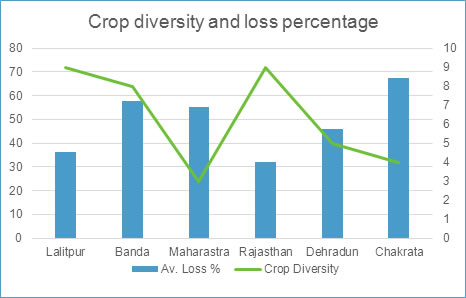
A recent study of Navdanya in 4 states of India on estimation of crop loss due to untimely rainfall at the time of crop ripening and harvesting period reveals that even in the adverse climatic conditions higher crop diversity was able to minimize the crop losses when compared with monoculture based industrial farms.